
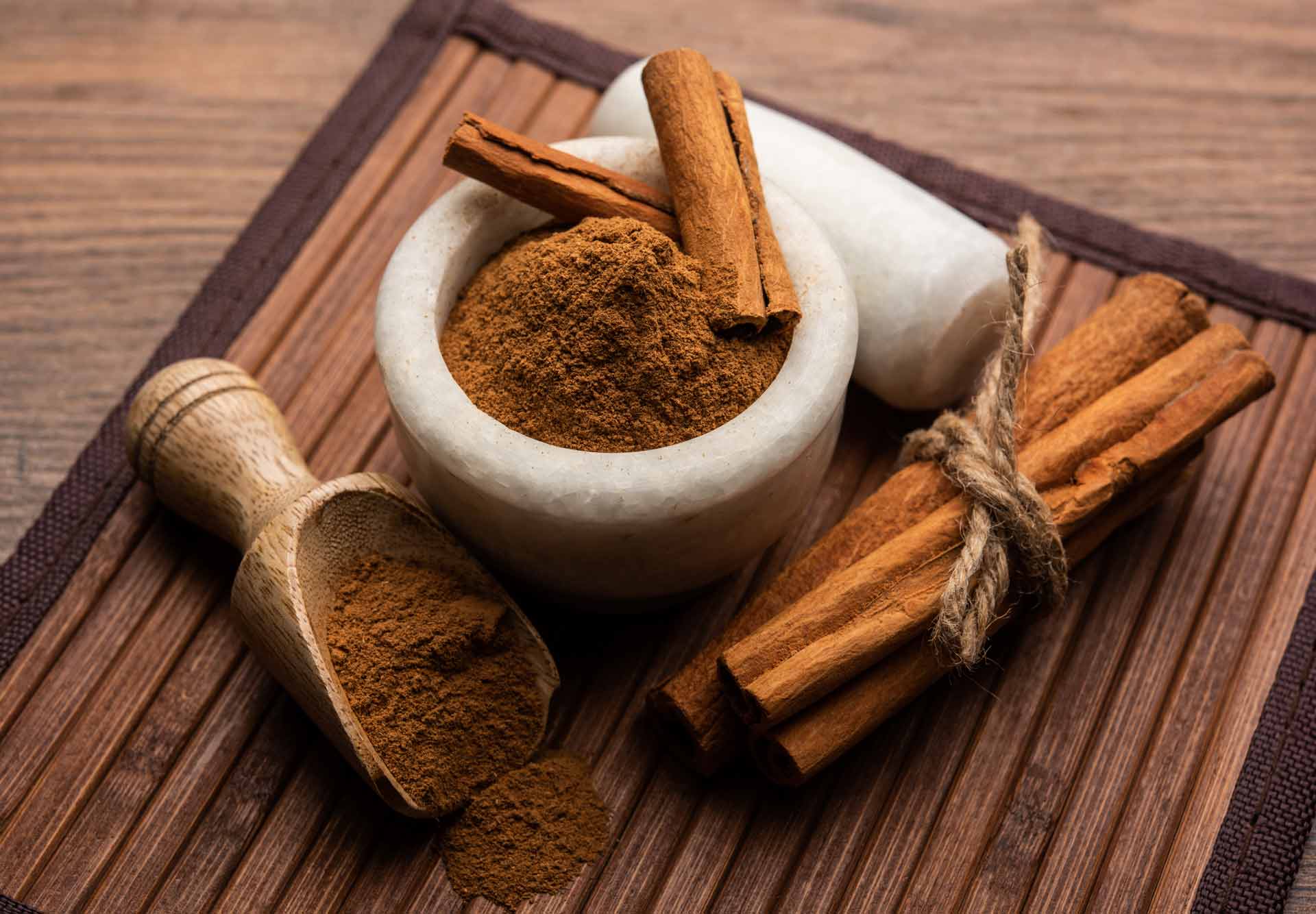
Ask Google whether cinnamon is anti-inflammatory and you get a confident yes. The research gives a more useful answer: the effect appears to be real, and it shows most clearly in people who already have raised inflammation and who keep taking it for months. There is also a safety question that depends entirely on which of the two cinnamons you are eating, and most people have never been told there are two. Knowing the difference is what lets you enjoy it sensibly.
Is cinnamon really anti-inflammatory?
A qualified yes, and the qualifications are the useful part.
An umbrella review published in 2024 pooled the existing meta-analyses of randomised controlled trials. It found effects on blood pressure and on markers of oxidative stress. On C-reactive protein, the marker of inflammation most often measured in blood, the result did not reach statistical significance. It landed at p = 0.051: far enough from the conventional threshold that nobody should be claiming proof, and close enough to it to be genuinely interesting.
Umbrella review, 2024Nutrition, Metabolism and Cardiovascular Diseases, 2024. View on PubMed
An earlier meta-analysis of six trials covering 285 participants did find a significant reduction in C-reactive protein. What makes it useful is where the effect concentrated: in people whose baseline CRP was already above 3 mg/L, and in trials that ran longer than twelve weeks. In everyone else it is often not detectable at all, but cinnamon moved the needle for people who had something to move, given enough time.
Meta-analysis, 6 trials, 285 participantsComplementary Therapies in Medicine. View the study

In type 2 diabetes, cinnamon shifted HbA1c but left inflammatory markers unchanged.
And in people with type 2 diabetes specifically, a systematic review found that cinnamon improved HbA1c and body mass index but did not shift inflammatory markers at all. Same spice, different population, different answer.
Systematic review, type 2 diabetesCinnamon improves HbA1c and BMI, but not inflammatory parameters, in type 2 diabetes. View the review
The effect looks real for people who start with raised inflammation and keep taking it for months.
What cinnamaldehyde actually does
Cinnamaldehyde is the compound responsible for cinnamon’s smell and most of its flavour, and it is the one most of the research follows. Alongside it sits a group of polyphenols, which is where cinnamon’s antioxidant activity comes from.
The clearest signal in the pooled trial data is on interleukin-6, a signalling protein involved in the inflammatory response. Results there were more consistent than on C-reactive protein. That distinction matters more than it sounds: “anti-inflammatory” is not one thing, and a spice can move one marker while leaving another untouched. Headlines flatten that. Bodies do not.
How much cinnamon should you take?
Two grams of cassia, less than a teaspoon, is the point at which a 60 kg adult reaches the coumarin limit.
Trials generally use between one and six grams a day. Reading across the analyses above, duration looks more important than dose: the studies that found effects tended to be the longer ones, not the ones using the most cinnamon.
One thing to know before you reach for the spice jar: if you are using cassia cinnamon, which almost everyone is, that trial range runs straight into a safety ceiling, explained in the next section. Since duration matters more than dose, a modest amount taken consistently is the useful approach.
In our tonicCinnamon brings its warm spice to every Natural Elixir tonic. The pattern in the research is consistency over months rather than a large amount occasionally. That is the one thing a daily ritual is genuinely good at, and it is the reason Natural Elixir is built around a 25 ml shot taken every day rather than a large dose taken when you remember. Our cinnamon is certified organic and we hold the grower’s certificate. Find it in Natural Elixir Classic, Lite and CBD Infused.
What is the downside of cinnamon?
Almost everything sold as cinnamon in a supermarket is cassia. The other kind, Ceylon, is a different species and is often labelled “true cinnamon”. They taste similar. They are not equivalent, and the difference is not a culinary one.
Cassia contains coumarin, a naturally occurring compound that is toxic to the liver in large enough amounts. Ceylon contains very little of it. Laboratory surveys put cassia in the region of 2,239 to 4,167 mg of coumarin per kilogram, with some batches reported considerably higher, against roughly a hundredth of that in Ceylon.
The European Food Safety Authority sets a tolerable daily intake for coumarin of 0.1 mg per kilogram of body weight. For a 70 kg adult that is about 7 mg a day. Germany’s federal institute for risk assessment calculates that a 60 kg adult reaches that limit at around two grams of average cassia cinnamon a day. Two grams is less than a teaspoon.
German Federal Institute for Risk AssessmentCassia cinnamon with high coumarin contents to be consumed in moderation. Read the assessment
Read that against the previous section and the tension is hard to miss: the doses used in the trials that show an effect begin at roughly the point where the safety ceiling for cassia starts. That is not a reason to avoid cinnamon. It is a reason to know which species you are eating, and to count your total across a day rather than per spoonful.

Coumarin is processed by the liver, which is why the species you use and your daily total both matter.
Our cinnamonNatural Elixir uses cassia cinnamon, not Ceylon.
What matters with coumarin is the total you take in across a day from every source: cereal, baking, spice jars and supplements included. Follow the dosage on the bottle, and if you are watching your intake closely, the figure to keep an eye on is your daily total rather than any single source. In the tonic, cinnamon is one of ten ingredients in a 25 ml serving, not a spoonful of loose powder.
Is turmeric or cinnamon better for inflammation?
They are studied for different things, so the question is slightly the wrong shape. Turmeric’s active compound, curcumin, carries the larger and more consistent evidence base where inflammatory markers are the primary outcome. Cinnamon’s strongest signals are metabolic: blood sugar, HbA1c, lipids. The two overlap, but the emphasis differs.
If you are picking one for a single purpose, that difference is more useful than a ranking. If you are not picking, they are commonly used together, and traditional recipes paired warming spices long before anyone measured a cytokine.
How to tell the two cinnamons apart

Ceylon rolls into many thin, papery layers. Cassia is a single thick curl. Ground, they are near enough identical by eye.
Worth knowing, because the label often will not tell you.
- Ceylon sticks are brittleMany thin, papery layers rolled together, closer to a cigar than a dowel, and a pale tan colour.
- Cassia sticks are hard and thickUsually a single rolled layer, and a deeper red-brown. Stronger, hotter, and what most supermarkets sell.
- Ground, the two are near indistinguishableWhich is exactly why the label and the country of origin matter more than anything you can see.
Common questions
How much cinnamon should I take to reduce inflammation?
Trials use one to six grams a day, and the ones that found effects ran for more than twelve weeks. If you use cassia, note that around two grams a day takes a 60 kg adult to the coumarin limit, so the useful range and the safe range overlap tightly.
Is turmeric or cinnamon better for inflammation?
Turmeric has the stronger evidence base where inflammatory markers are the main outcome. Cinnamon’s best evidence is metabolic. They answer different questions rather than competing.
How do I use cinnamon as an anti-inflammatory?
Consistently and in food amounts, rather than in bursts. The research favours months of ordinary intake over short courses of large doses, and food amounts keep you clear of the coumarin ceiling.
What is the downside of cinnamon?
Coumarin in cassia, which the liver processes and which has a tolerable daily intake of 0.1 mg per kg of body weight. Beyond that: mouth irritation, blood sugar effects at high intakes, and interactions with some medications.
Is cinnamon right for everyone?
A few things are worth knowing, none of them a reason to panic and all of them reasons to be sensible. Cinnamaldehyde can irritate the mouth, and it triggers allergic reactions in some people. Never swallow dry powder on its own: it is a genuine choking and aspiration hazard, and the viral challenge that popularised it sent people to hospital. Large amounts can lower blood sugar, which matters if you take medication for diabetes. Coumarin is processed by the liver, so high intakes can interact with blood thinners and other medicines cleared the same way. And anyone with a liver condition, anyone pregnant, and anyone on regular medication should make cinnamon a conversation with their doctor.
This article is for general information and is not medical advice. Natural Elixir is a natural health tonic and is not intended to diagnose, treat, cure, or prevent any disease. Always speak to a healthcare professional before changing your diet, supplements, or medication, and never stop prescribed treatment without medical guidance.