

Does cold weather give you a cold?
No, and not quite. Cold air cannot give you a cold, because a cold is a virus and weather does not make viruses. But the old belief is not simply wrong either: being cold appears to make it easier for a virus you have already met to get a foothold, and in 2022 somebody finally worked out why.
This is one of those beliefs that survives being corrected. Your mother said it, your biology teacher told you it was nonsense, and your mother kept saying it. Both of them had part of it.
We make a daily botanical shot that contains lemon, so take us as interested parties. Everything below is sourced.
Where the cold weather myth came from
It came from the most reasonable place a belief can come from: people noticed a pattern, centuries before anyone knew what a virus was.
Colds arrive in winter. Children who get soaked and stay out get sniffles. That correlation is real, it repeats every year, and until the 1950s there was no competing explanation available. The word itself carries the theory: we called the illness a cold because we thought the cold caused it. Most languages did the same thing.
Then virology arrived, rhinovirus was identified, and the belief was demoted to an old wives’ tale in a single generation. Which was fair on the mechanism and slightly unfair on the observation.
What actually gives you a cold
A virus, and you have to meet one. Around two hundred can do it, and rhinoviruses account for most. No amount of cold, wet, wind or wet hair will produce a cold in someone who has not encountered the virus, which is why researchers in Antarctica famously stop getting them.
The correction is narrower than the one most of us were taught. Cold weather does not cause colds. Whether it makes catching one more likely is a completely different question, and the answer to that turns out to be yes.
The part your gran got right
Two findings, and the first is genuinely elegant.
The inside of your nose is your first line of defence, and its temperature tracks the air you breathe. When a virus arrives, cells in the nasal lining release a swarm of tiny sacs called extracellular vesicles, which work as decoys: the virus binds to them instead of to your cells.
In 2022, researchers at Mass Eye and Ear dropped the nasal temperature by a few degrees and measured what happened to that response. The number of decoys released fell by about 42 per cent, and the antiviral proteins carried by the ones that were released were compromised. It is the first biological mechanism anybody has produced for why respiratory viruses spike in the cold.
Huang et al., J Allergy Clin Immunol, 2022Cold exposure impairs extracellular vesicle swarm-mediated nasal antiviral immunity. Read the study
Drop the temperature inside the nose by a few degrees and it releases about 42 per cent fewer of its antiviral decoys.
The second is older and stranger. In 2005 a team in Cardiff put 180 volunteers through either a foot chill in cold water or a control procedure, then asked them to score cold symptoms twice a day. Thirteen of the ninety chilled reported a cold in the next four to five days, against five of the ninety controls, and their symptom scores were higher. The authors were careful: chilling produced symptoms in roughly one in ten, and whether those symptoms represented a real infection was not established.
Johnson & Eccles, Family Practice, 2005Acute cooling of the feet and the onset of common cold symptoms. 180 volunteers. Read the study
Add the dull explanations to those two and winter is fully accounted for: cold weather puts everybody indoors together, breathing the same air, and dry air suits airborne viruses. Nobody needed a myth. But “put a coat on” was never quite the nonsense it got written off as.
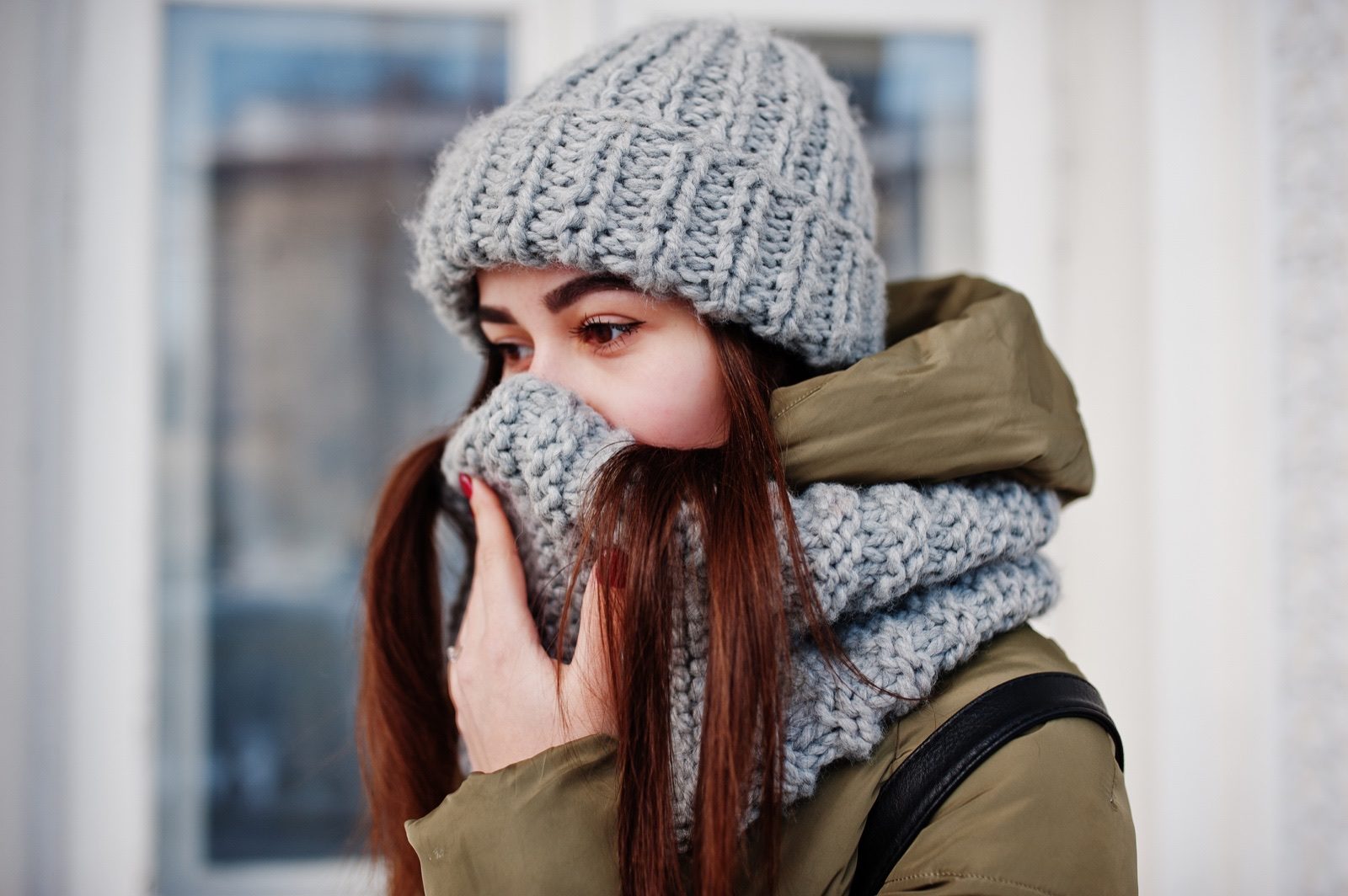
The temperature inside your nose follows the air you breathe. A scarf over it is doing something specific.
Does vitamin C stop you catching a cold?
No. Taking vitamin C every day does not reduce how often you catch a cold.
The Cochrane review pooled 29 trial comparisons and 11,306 people, and regular vitamin C had no effect on cold incidence in the ordinary population. That is about as settled as nutrition research gets, and it has been settled for years while the shelves kept filling up.
Two things it did find. Regular intake shortened colds modestly and consistently: about 8 per cent in adults and 14 per cent in children. And in five trials of people under short bursts of extreme physical stress, marathon runners, skiers and soldiers on subarctic exercise, it halved the risk of catching one.
Hemilä & Chalker, Cochrane Database of Systematic Reviews, 2013Vitamin C for preventing and treating the common cold. 29 comparisons, 11,306 participants. Read the review
So the popular version, that vitamin C keeps colds away, is wrong. The real finding is smaller and more interesting: it does not change whether you get one, it slightly changes how long you have it, and it does considerably more for a body already under real physical strain than for one sitting at a desk.

Vitamin C shortens a cold slightly. It does not stop you catching one.
What actually helps in winter
- Wash your hands, properlyRhinovirus travels beautifully on hands and door handles. This is dull and it is the single most effective thing on the list.
- Open a windowIndoor crowding and still, dry air is most of what makes winter winter. Ventilation costs nothing.
- SleepShort sleep is one of the few things with a genuine, repeatable association with catching more colds.
- Keep warm, and stop apologising for itOn the 2022 nasal finding, staying warm is no longer folklore. A scarf over your nose in the cold is doing something specific.
- Eat well every day, not in burstsVitamin C has a recognised role in the normal functioning of the immune system, and garlic has a small evidence base of its own here.

The dullest item on the list and the most effective.
The version that actually holds up
Nothing on that list is clever, and that is the whole finding. What carries somebody through a winter in decent shape is not one trick but the ordinary things done repeatedly: sleeping properly, moving most days, keeping warm, washing your hands, and giving your body good ingredients every single day rather than in bursts when you remember.
The last of those is the one people find hardest to keep up. Eating well is easy in a good week and the first thing to go in a busy one, and winter is full of busy weeks.
The habits that hold up in winter are the dull ones done daily. Eating well is the first to go in a busy week.
Where we come into itA daily shot is ten seconds and ten raw plants, lemon among them, which is where the vitamin C comes in. It is a food, taken every morning, and it sits alongside the sleep and the movement. That is what we built it for: the easiest of the daily habits to actually keep. What is in it, or what a daily tonic is for.
And the satisfying part of this one is that nobody has to be the fool. The mechanism belonged to the virologists and the pattern belonged to your gran, and it took until 2022 for anyone to measure the bit she was right about.
This article is for general information and is not medical advice. Natural Elixir is a natural health tonic and is not intended to diagnose, treat, cure, or prevent any disease, including the common cold or influenza. Always speak to a healthcare professional before changing your diet, supplements, or medication, and never stop prescribed treatment without medical guidance.